24 hours
Featured day cruise
Free cancellation to 24 hours
- Cancel freeUp to 24 hours
- Reviews13,162
- From$40
Your own checklist
9-item checklist
Tick items as you finish them. We save your progress on this device.
0 / 9 ready
All ticked. Only the date and your pickup option are left to choose.
Save a placeThe seasons on the bay as the official sources describe them, when to visit Ha Long Bay for clear water, what the tides and fog change on a day cruise and how a storm stops the boats.
Editorial team, halongbaydaytrip.click · Updated November 17, 2026 · Read in 8 min
Overview
The bay has a hot, humid tropical climate with a cooler winter, and the Management Department describes it in simple blocks. Winter runs from November to March and averages 15 to 20 degrees Celsius, while summer runs from May to September and averages 26 to 27 degrees Celsius.1 April and October are the transitional months, and the annual average is 18 to 19 degrees Celsius.1 That is a wider swing than most first-time visitors expect.
The national tourism authority paints the same picture in softer words, with a hot, humid summer and a cooler, drier winter under a light mist.5 The point for a day cruise is that the sea temperature and the air feel different on deck than they do in Hanoi, and the boat is open to the wind. A shirt that is perfect in a Hanoi street at noon can be thin at sunset on the water, and the other way round in July.
None of this changes the plan to go. It changes what you bring and how you read a forecast, and it is worth some thought before you choose a date. A day cruise runs in every season, and the people who plan it well simply match the layers, the sun cover and the expectations to the month. The sections below give the seasonal pattern first, then the tides, fog and storms that actually move a day boat.
Seasons side by side
| Months | Air and sky | Source |
|---|---|---|
| December to March | Cool to cold, misty, cloudy11 | National authority11 |
| April to June | Warm to hot, clear and sunny11 | National authority11 |
| June to August | Stormy, hot and humid12 | National authority12 |
| September to November | A mix of sun and clouds, warm to cool12 | National authority12 |
| November to March | Averages 15 to 20 degrees Celsius1 | Management Department1 |
| May to September | Averages 26 to 27 degrees Celsius1 | Management Department1 |
Month groups overlap because the two sources split the year differently; there is no official monthly average in the sources used here.11,1
Official sources give seasons rather than a month-by-month grid, so this page reads the bay in month groups. The national tourism authority describes December to March as cool to cold with mist and cloud, and April to June as warm to hot with clear, sunny skies.11 June to August it calls stormy, hot and humid, and September to November a mix of sun and clouds, warm to cool.12 The table below sets those groups beside the Management Department's temperatures.
January deserves its own warning. The national authority says temperatures in January can be frigid, so warm layers are needed.13 On a boat the wind chill adds to that, and a day cruise in the coldest weeks asks for a proper jacket, a scarf and a change of dry socks. Swimming in those weeks is a matter for the operator and your own judgment, because the source does not say the swim stop runs in winter.
The warm half of the year is the opposite problem. Hot, humid weather with storms in June to August means strong sun between the squalls, and the page for our featured cruise flags busy boats in the summer months of June to August, and at the weekend. If you can pick, a weekday in the shoulder months gives the most comfortable air and the thinnest crowd of boats at every stop.
Degrees Celsius
Ranges of average temperature as the Management Department gives them: winter November to March, annual average, and summer May to September.1
The national authority recommends the stretch from April to June and again September to November, for a better chance of sunny skies and pleasant temperatures.2 On its Ha Long page it names September to November as the best window, with clear, calm days for cruising in autumn and spring, and a hot summer with the chance of storms.14 Read together, April to June and autumn are the safest months for a clear cruise.
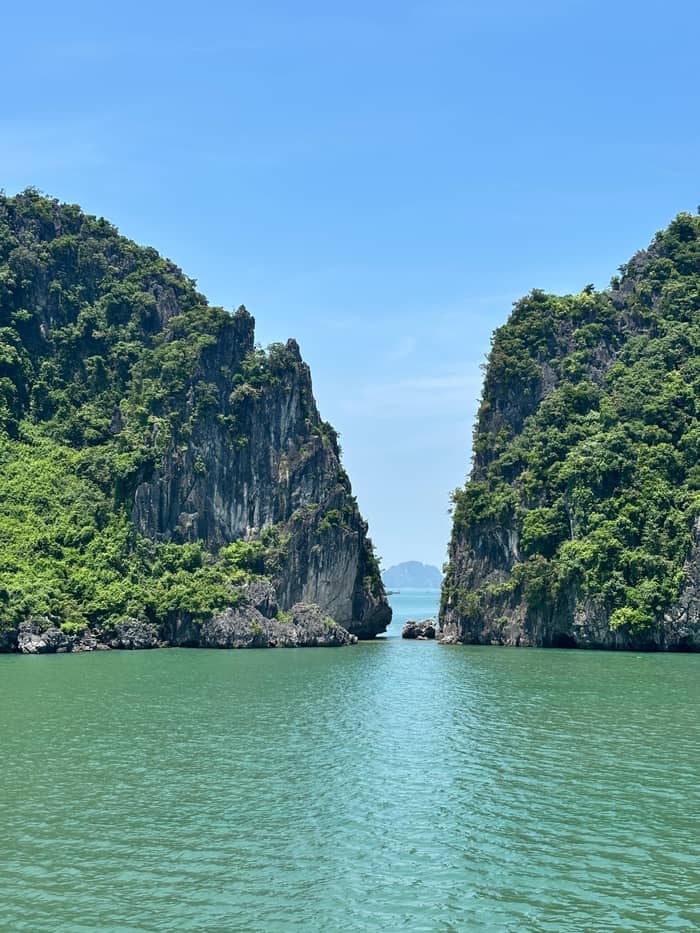
Other times of year have their own character. The same authority says downpours or heavy mist are common outside those months, and that tropical storms can sometimes cause cruise cancellations.4 It also says that if you are on the water in that weather you can see a more mystical side of the bay, with the karsts shrouded in mist.15 A misty day is not a lost day, but it is a different one, and photographs from a mist day look like ink drawings.
Fog follows the seasons. The national authority writes that autumn and winter bring fog to the region while summer delivers crisp visibility, dramatic skies and warm nights.17 If clear distance views matter to you, a summer morning gives the sharpest outlines but carries the storm risk described below, and a calm autumn day is the better compromise. If mood matters more than distance, winter fog suits the stone towers well, and the bay looks entirely different in it.
Choose your months
Start from your priority and the season that fits follows.
If I want sunny, clear skies
April to June
The national authority lists April to June as warm to hot with clear skies.11
If I want calm autumn light
September to November
The authority's Ha Long page names September to November as the best window.14
If I like misty, moody photographs
Winter
Misty weather shows a more mystical side of the bay.15
If I want to avoid storm risk
Spring months
The forecasting centre flags July to August convergence and autumn peaks.6,16
If I dislike crowds
A weekday outside summer
Its page flags summer and weekend crowds.
What the listings say about weather
24 hours
Free cancellation to 24 hours
Rain or shine
Runs rain or shine
Flexible
Weather can change the plan
Rain is heavy over the year. The Management Department gives a yearly rainfall average between 2,000 mm and 2,200 mm, which is a lot of water for a bay that people think of as a sunny postcard.3 The rain also freshens the sea, and the department notes that salinity differs between the rainy and dry seasons, which is one more sign that the bay changes with the calendar. Heavy rain changes the light and the views, and it can change how much you want to spend in the water, so decide on the morning whether the swim stop is for you.
The islands shelter the water, and that is why a cruise boat is usually a steady ride. The Management Department says the screen of islands holds the average wave height to about 0.5 m, rising to 2.5 m on stormy days.20 That shelter is why kayaking and swimming are sold as regular items on a day cruise, and the same figure shows why a storm day is so different from an ordinary one.
Tides matter more than most visitors guess. The bay has one high and one low tide a day, with an amplitude from 1.9 m to 4.6 m, and low tides come in March, April, August and September while high tides come in January, June, July and December.21,19 At Luon Cave the official guide says that on high-tide days visitors crouch on the boats to pass through, while Ba Ham Lake can only be entered at low tide.22,23
A storm day in order
Forecast
The national forecasting centre follows the storm and the province hears the track.6
Notice
The People's Committee suspends sightseeing, entertainment and swimming from a stated hour.7
Permits
Quang Ninh suspends vessel permits from a set time until the final bulletin.8
Return
On one storm day 300 trips carrying 8,394 visitors returned to shore.9
Overnight
Overnight permits can be suspended and boats must return passengers before 6:00 PM.10
Reopening
The suspension runs until the last storm bulletin is out.8
Storms are the real cancellation risk. The national forecasting centre has said that tropical convergence is usually stronger between July 11 and August 10, which brings thunderstorms, tornadoes and high waves at sea.6 In another year the meteorological agency expected storms to peak between September and November.16 So the risk is not one month: it runs from midsummer into autumn, with the quiet months in the spring.
When a storm approaches, the province acts early. For Storm Talim the People's Committee suspended sightseeing, entertainment and swimming in the bay from 3 PM on July 17.7 For Storm Prapiroon the same kind of notice began from Monday noon.24 The Management Department also relays a June 2025 notice for the first storm of that season: overnight permits were frozen, and day boats had to bring guests ashore before 6:00 PM on June 13, 2025.10
Large numbers of people can be affected in a few hours, which is why the notices are issued early and in plain terms. Before Typhoon Ragasa, Viet Nam News reports, Quang Ninh had 390 tourist and restaurant vessels, and 300 trips carrying 8,394 visitors had already returned to shore.9 The suspension of permits took effect from 10 AM and was to last until the last bulletin on the storm.8
Video
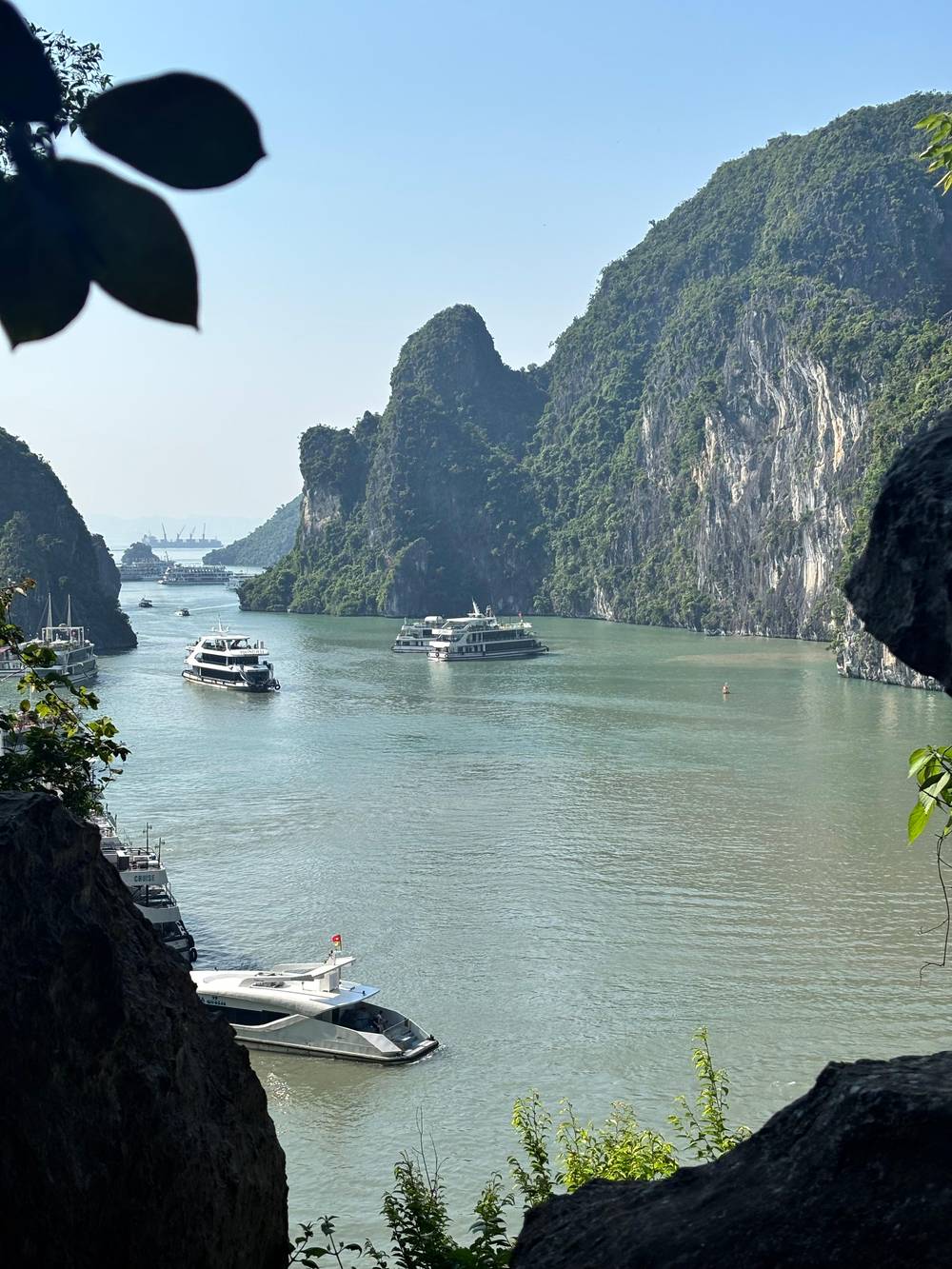
Asia Pioneer Travel on YouTube · The video stays unloaded until you press play.
you can experience a more mystical side of Ha Long Bay, with its famous karsts shrouded in mist.
A stopped boat is a cancelled sailing, not a mystery. The authority suspends departure permits or sightseeing, boats come back, and the operator tells you the same day or the evening before, by the channel you booked with. Our featured listing says guests get a confirmation message and that pickup details arrive within 24 hours of booking, so keep the messaging app on. Look at your phone before leaving the hotel in any month with a storm in the news.
What you are owed depends on the listing's terms. Our featured cruise allows free cancellation until 24 hours before departure, refunded in full. A Lan Ha listing runs in any weather but drops out when a storm arrives. A luxury day cruise says the itinerary may change because of weather and tide level. None of the records spells out a refund for a storm cancellation, so ask the operator in writing before you pay.
The province has also tightened its own safety system in the last year. Viet Nam News reports that warning units for thunderstorms, squalls and lightning are going up over the bay and its neighbour Bai Tu Long.25 Every tourist boat must carry an identification system, and rescue craft with a medical vessel patrol the water.26,27 Those steps do not make the sea calmer, but they make a stop order faster and clearer.
The Ha Long Bay hours for a day cruise are regulated. Viet Nam News reported that from October 20, 2024, in summer (April 1 to October 31) day-trip boats can depart from 5:00 AM and return by 8:00 PM, and in winter (from November 1 to March 31) they depart from 5:30 AM and return by 7:00 PM.28,18 The Management Department's older fee page lists the daily visit as 6:30 AM to 6:30 PM, so treat the newer news report as the current rule and the fee page as the older one.29
Overnight boats follow a different clock. They have to be at their assigned anchorages by 6:30 PM in winter and by 7:00 PM in summer.30 That matters to a day guest because the bay thins out after the day boats leave. The national authority notes that once the day-trippers have gone back to the mainland, the gulf goes quiet for those who stay overnight.31 Day guests see the busy half of the bay, and that is a fact to plan around.
Our featured cruise follows the daytime pattern. Guests who skip the Hanoi transfer arrive at the Tuan Chau marina at 11:15 AM, the boat reaches Tuan Chau Harbor at 11:30 AM and the bus returns to the Hanoi Old Quarter by 9 PM. The quietest hours are the first and the last of the water day, and the busiest are the middle hours when every boat is at a cave or a beach. The Management Department says Ti Top is one of the most popular spots.32
FAQ
The Management Department gives that average for November to March.1
That is the average for May to September.1
The national authority suggests those windows for sunny skies and pleasant temperatures.2
The national authority says autumn and winter bring fog while summer delivers crisp visibility.17
That is the yearly average the Management Department gives.3
Sources
Continue reading
Planning a Ha Long Bay day from Hanoi? Ask a real person here.